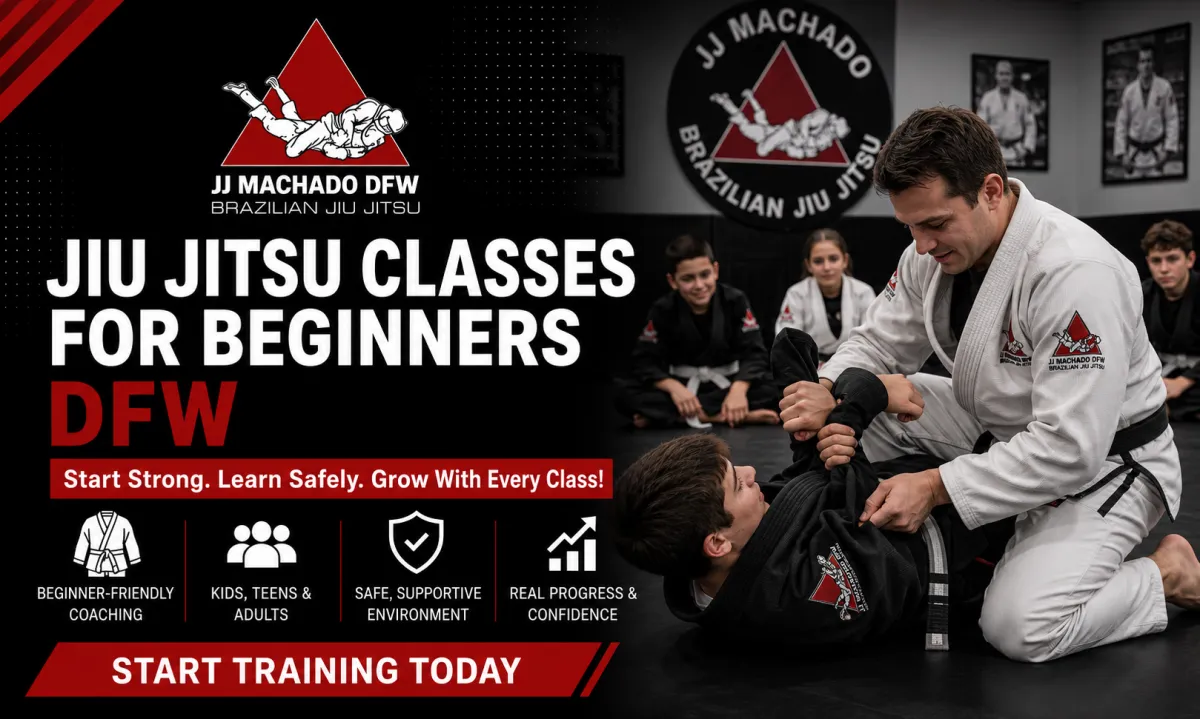
Jiu Jitsu Classes for Beginners in DFW: What to Expect in Your First 90 Days
Starting Brazilian Jiu-Jitsu can feel intimidating when you do not know what happens inside a class. You may wonder whether you are fit enough, flexible enough, young enough, or strong enough to begin. You may also worry about training with experienced students or not understanding the techniques.
The reality is that every skilled Brazilian Jiu-Jitsu student began without knowing the positions, movements, or terminology.
Jiu Jitsu Classes for Beginners DFW should give new students a clear and gradual introduction to training. You should not be expected to arrive in perfect physical condition or understand what to do on your first day. A beginner-friendly program teaches fundamental movement, safe partner practice, basic positions, and technical control one step at a time.
This guide explains what to expect during your first class, what you should wear, how Gi and No-Gi training differ, and what realistic progress may look like during your first 90 days.
Do You Need to Get Fit Before Starting Jiu Jitsu?
Many beginners delay their first class because they believe they should improve their fitness first. They may decide to lose weight, build more strength, improve their cardio, or become more flexible before entering an academy.
You do not need to complete a separate fitness program before beginning Brazilian Jiu-Jitsu.
Training itself can help you gradually develop conditioning, coordination, balance, mobility, and body awareness. The first classes may feel physically demanding because your body is learning unfamiliar movements, but a responsible beginner program should allow you to progress at a manageable pace.
Being strong can be useful, but strength does not replace timing, positioning, leverage, or technique. In fact, one of the first lessons many beginners learn is that trying to force every movement can make them tired very quickly.
Your starting fitness level is simply your starting point. The objective is not to perform like an experienced student during your first week. It is to train consistently enough to become more comfortable and efficient over time.
What Happens Before Your First BJJ Class?
Before attending, contact the academy and confirm the current schedule. Explain that you are a new student and ask which class is most appropriate for your age and experience level.
You should also ask whether the class is Gi or No-Gi and what clothing is required. Requirements can differ between programs and locations, so it is better to receive instructions directly from the academy instead of buying equipment immediately.
Try to arrive early enough to introduce yourself, complete any required forms, tour the training area, and speak briefly with the instructor. Let the coach know about any previous injuries or physical limitations that may affect your training.
You do not need to study techniques online before attending. Watching videos without a training partner or instructor may create more confusion than preparation. Your first objective is to understand the academy routine and follow the coach’s instructions.
What to Expect During Your First Jiu Jitsu Class
The exact structure may vary, but a beginner Brazilian Jiu-Jitsu class usually includes several stages.
The class may begin with a warm-up or movement drills. These can include exercises related to posture, balance, hip movement, coordination, or safe ways to move on the ground.
The instructor will then demonstrate a technique or position. A good demonstration breaks the movement into understandable steps and explains important safety details.
Students normally practice the technique with a partner. This part of the class is often called drilling. You and your partner repeat the movement with controlled resistance so both of you can understand the mechanics.
Depending on the class and your readiness, there may also be positional training or controlled sparring. Beginners should not feel pressured to treat this like a fight. The purpose is to practice movement, recognize positions, and learn how to respond while a partner provides realistic resistance.
Your first class may feel unfamiliar and mentally demanding. You may forget the technique immediately after the instructor demonstrates it. You may also confuse left and right or struggle to coordinate your arms and legs.
That is normal. Brazilian Jiu-Jitsu is a new movement language, and fluency develops through repetition.
What Should You Wear to Your First Class?
Contact the academy before your first visit because clothing requirements depend on whether you are attending a Gi or No-Gi class.
For No-Gi training, academies commonly require fitted athletic clothing, such as a rash guard or athletic shirt with shorts or leggings that do not contain exposed zippers, metal pieces, or pockets that could catch fingers.
For Gi training, you will eventually need a Brazilian Jiu-Jitsu Gi consisting of a jacket, pants, and belt. New students should ask whether the academy provides a trial Gi or whether they need to bring their own.
Regardless of the class type, arrive in clean clothing and maintain short fingernails and toenails. Remove watches, rings, necklaces, earrings, and other jewelry before training.
Bring water and basic personal items, but avoid bringing shoes onto the training mat. Follow the academy’s hygiene and footwear rules throughout your visit.
Gi vs No-Gi for Complete Beginners
Brazilian Jiu-Jitsu can be practiced in both Gi and No-Gi formats. Both can be appropriate for beginners, but they create different training experiences.
Gi Training
The Gi is the traditional Brazilian Jiu-Jitsu uniform. Students can use parts of the jacket and pants to establish grips and control movement.
These grips can slow certain exchanges and give beginners more time to recognize positions. Gi training places significant emphasis on posture, grip management, pressure, balance, and technical control.
Because there are many possible grips, Gi training can initially feel detailed and complex. Beginners do not need to learn every grip immediately. Start by understanding a few safe and effective positions.
No-Gi Training
No-Gi students usually wear fitted athletic clothing. Because there is less material to grip, training often relies more heavily on body positioning, movement, underhooks, head position, and control of the limbs.
No-Gi exchanges may feel faster, especially when students become sweaty and harder to control. However, beginner instruction should still focus on safe movement and fundamental positions rather than speed alone.
JJ Machado DFW lists Adult Gi and No-Gi programs, and its location pages direct new students to confirm the appropriate class and clothing requirements before attending.
Your First 30 Days of Brazilian Jiu Jitsu
During your first month, most of your progress will involve becoming familiar with the training environment.
You will begin learning common terms and recognizing basic positions. These may include closed guard, side control, mount, back control, and standing positions. You are not expected to use every position effectively yet.
You may also learn basic movements such as bridging, hip escapes, technical stand-ups, posture control, and safe ways to fall or return to your feet.
One of the most valuable lessons during the first 30 days is learning how to train with a partner. This means using controlled movement, listening to instructions, respecting submissions, and stopping immediately when someone taps.
Your conditioning may begin improving, but do not judge your progress only by how tired you feel. Better breathing, calmer decisions, improved balance, and greater familiarity with the class routine are meaningful signs of development.
Days 31–60: Recognizing Positions and Making Connections
During the second month, movements that initially felt unrelated may begin connecting.
You may recognize when you are in a difficult position and remember one appropriate response. Instead of trying random movements, you may begin protecting your posture, controlling distance, or creating the space needed for an escape.
You may also start noticing how much energy you use. Many new students tense their entire body whenever a partner moves. As you become more comfortable, you can begin relaxing in safer positions and using effort more selectively.
This does not mean training becomes easy. You will still forget techniques and make mistakes. The difference is that you may understand why the mistake happened.
For example, you may realize that you lost balance because your feet were too close together, or that an escape failed because you tried to move before creating space.
Recognizing these details is an important form of progress.
Days 61–90: Developing a Sustainable Training Routine
By the third month, many beginners feel more familiar with the academy, instructors, and other students.
You may start developing a small group of techniques that you recognize more consistently. This does not need to be a large collection. Understanding one escape, one control position, and one safe way to move from each common situation is more valuable than knowing many techniques without being able to apply them.
You may also begin setting more realistic expectations. Instead of measuring success by whether you “won” during training, you can focus on completing smaller objectives.
A successful round might mean maintaining good posture, escaping one position, remembering to breathe, or responding safely when your partner increases pressure.
At this stage, consistency becomes more important than early excitement. Choose a schedule that fits your responsibilities and that you can continue over the long term.
How Often Should a Beginner Train?
For many beginners, two or three classes per week can provide a useful balance between learning, recovery, and other responsibilities.
Training once per week can still be beneficial, but progress may feel slower because more time passes between repetitions. Training almost every day may be difficult to sustain when your body is still adapting to the movements and physical contact.
The right frequency depends on your age, schedule, recovery, previous athletic experience, and personal goals.
Beginners should avoid comparing their schedule to competitors or advanced students. A consistent two-day routine is usually more useful than training intensely for one week and then disappearing for a month.
Give your body time to adapt. Normal muscle fatigue can occur when beginning a new activity, but sharp pain, worsening discomfort, or symptoms related to an existing injury should not be ignored. Communicate with your instructor and seek appropriate medical guidance when needed.
Common Beginner Mistakes to Avoid
Using Too Much Strength
New students often try to solve every position by pushing, pulling, or holding as hard as possible. This usually causes early fatigue and can make technical learning more difficult.
Use enough effort to participate safely, but remain willing to pause, listen, and adjust your position.
Holding Your Breath
People commonly hold their breath when they feel pressure or become focused on completing a movement. Steady breathing helps you remain calmer and use energy more efficiently.
Trying to Win Every Round
Training is not a competition between classmates. Sparring and positional practice are opportunities to test your understanding against resistance.
You will make mistakes, lose positions, and tap to submissions. Those experiences provide information about what you need to improve.
Comparing Yourself to Experienced Students
A student who has trained for several years should move more efficiently than someone attending their third class. Their progress does not mean you are failing.
Compare your current understanding with what you knew several weeks earlier.
Collecting Too Many Techniques
Watching large numbers of technique videos can overwhelm beginners. Focus on the positions and movements currently being taught in class.
A small number of techniques practiced repeatedly creates a stronger foundation than a long list of movements you cannot remember.
Ignoring Hygiene and Safety Rules
Clean training clothing, trimmed nails, responsible partner behavior, and immediate respect for tapping are essential parts of Brazilian Jiu-Jitsu.
Good training partners protect one another while still providing an appropriate challenge.
Can Brazilian Jiu Jitsu Help With Fitness?
Brazilian Jiu-Jitsu combines technical learning with physical movement. A class may challenge your coordination, cardiovascular endurance, grip, core control, balance, and mobility.
However, beginners should not approach every session as a test of maximum intensity. Technical improvement often comes from slowing down enough to understand the movement.
Your early fitness progress may appear in practical ways. You may recover more quickly between rounds, move without becoming exhausted immediately, maintain better posture, or feel more comfortable during warm-ups.
Results vary according to training frequency, nutrition, sleep, current fitness, and other individual factors. Brazilian Jiu-Jitsu can be part of an active lifestyle, but it should not be presented as a guaranteed weight-loss or health solution.
Learning Self-Defense Without False Confidence
Brazilian Jiu-Jitsu teaches concepts involving leverage, positioning, control, escapes, and responding to resistance.
Training with partners can help beginners become more familiar with physical pressure and decision-making in difficult positions. It can also show students why technique and composure matter when strength alone is not enough.
However, no martial art can guarantee safety or determine the result of every real-world confrontation.
Responsible self-defense training should include awareness, avoidance, de-escalation, and recognition of when leaving or seeking help is the safest response.
The objective is not to make beginners feel invincible. It is to help them develop practical skills while understanding the limits and responsibilities of their training.
How to Choose Beginner-Friendly Jiu Jitsu Classes in DFW
A beginner-friendly academy should provide more than an introductory offer. The long-term training culture matters.
Pay attention to how instructors explain techniques and respond when students ask questions. New students should receive clear guidance without being made to feel embarrassed for not understanding.
Observe how experienced students train with beginners. Responsible partners adjust their speed and resistance while still helping new students experience realistic movement.
The academy should also maintain clear safety and hygiene expectations. Students should respect tapping, use controlled techniques, and follow the instructor’s directions.
Review the schedule and determine whether the class times are realistic for your routine. The best program for you is one that provides strong instruction and that you can attend consistently.
You can also review the academy’s Brazilian Jiu-Jitsu instructors, program structure, and available locations before scheduling your first visit.
Starting Jiu Jitsu Classes for Beginners DFW at JJ Machado
JJ Machado DFW provides Brazilian Jiu-Jitsu programs for adults, kids, and teens. Its current program information includes Adult Gi, Adult No-Gi, and age-based youth training.
New students can review the current schedule for the nearest location:
The location pages advise beginners to contact the academy before attending so the team can confirm the latest class time, recommend an appropriate session, and explain clothing requirements.
You do not need previous martial arts experience to take the first step. Arrive ready to listen, move carefully, and learn one detail at a time.
Frequently Asked Questions About Beginner BJJ Classes in DFW
Can I join Jiu Jitsu classes for beginners in DFW with no experience?
Yes. Beginner training is intended for students who do not already understand Brazilian Jiu-Jitsu positions or techniques. JJ Machado DFW’s location pages state that new students can begin without previous martial arts experience.
Am I too old to start Brazilian Jiu Jitsu?
Adults begin Brazilian Jiu-Jitsu at many different ages. The appropriate training pace depends on your current condition, recovery, goals, and any physical limitations. Speak with the academy and seek medical advice when you have health or injury concerns.
Do I need to lose weight before starting?
No specific weight is required to begin learning. Start at your current level and allow your conditioning to develop gradually through consistent, responsible training.
Will I have to spar during my first class?
Class structure varies. Some academies introduce beginners to controlled positional training, while others may delay open sparring. Ask the instructor what to expect and communicate when you are uncomfortable.
Should I start with Gi or No-Gi?
Both formats can teach valuable fundamentals. Your decision may depend on the available schedule and your training interests. Contact the academy before attending to confirm which beginner sessions are available.
What should I bring to my first class?
Bring water and arrive in clean athletic clothing approved by the academy. Remove jewelry and keep your fingernails and toenails short. Confirm specific Gi or No-Gi clothing requirements before your visit.
How long does it take to feel comfortable in BJJ?
There is no fixed timeline. Some students become comfortable after several classes, while others need more time. Consistent attendance generally makes the terminology, positions, and class routine feel more familiar.
How many BJJ classes should a beginner attend each week?
Two or three weekly sessions may be manageable for many beginners, but the right schedule depends on your recovery, responsibilities, and physical condition. Choose a routine you can maintain consistently.
Take the First Step With JJ Machado DFW
You do not need to arrive with advanced fitness, martial arts experience, or complete confidence.
Jiu Jitsu Classes for Beginners DFW allow you to learn gradually through instruction, repetition, and controlled partner training. Your first 90 days are not about mastering Brazilian Jiu-Jitsu. They are about building safe habits, understanding basic positions, and creating a routine you can continue.
Explore the available programs, select your nearest JJ Machado DFW location, and contact the academy to confirm the most appropriate class for your first visit.
