Kids Brazilian Jiu-Jitsu in Colleyville, TX: What Parents Should Know
Choosing the right activity for your child involves more than finding something to fill a few hours after school. Parents want an activity that keeps children moving while also helping them develop focus, confidence, discipline, and respect.
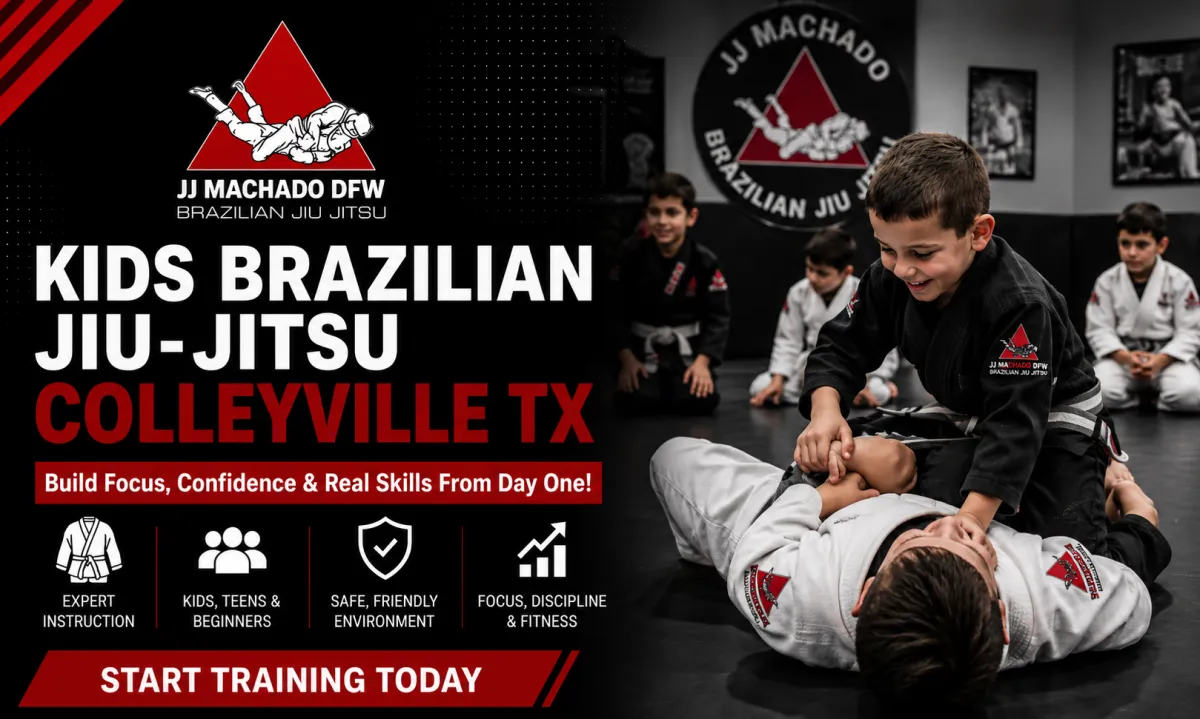
Kids Brazilian Jiu-Jitsu in Colleyville, TX gives young students an opportunity to build these qualities through structured, age-appropriate training. Rather than relying only on repetitive exercises, Brazilian Jiu-Jitsu encourages children to listen, move, solve problems, work with training partners, and learn from mistakes.
At JJ Machado DFW Colleyville, children do not need previous martial arts experience before joining a class. The youth program is divided into different age levels so students can learn at a pace that fits their stage of development.
This guide explains what parents can expect from kids BJJ classes, how training may support a child’s development, and what to consider before choosing a Brazilian Jiu-Jitsu academy in Colleyville.
Is Brazilian Jiu-Jitsu Right for Your Child?
Children come to Brazilian Jiu-Jitsu for many different reasons. Some are naturally active and need a positive way to use their energy. Others may be shy, cautious, or uncomfortable joining group activities. Some children enjoy sports but prefer individual progress over traditional team competition.
Brazilian Jiu-Jitsu can accommodate different personalities because progress does not depend on being the fastest, strongest, or loudest student in the room. Children learn movements step by step and develop their abilities through practice.
A child who is hesitant during the first few classes can gradually become more comfortable participating. An energetic child can learn when to move, when to stop, and when to listen. A child who becomes frustrated by difficult tasks can begin to understand that improvement often requires repetition.
BJJ will not produce exactly the same result for every child, and no activity can guarantee a particular behavioral change. However, a structured training environment can give children regular opportunities to practice patience, responsibility, controlled movement, and respectful communication.
What Happens in a Child’s First BJJ Class?
It is normal for a child to feel excited, nervous, quiet, or uncertain before entering their first Brazilian Jiu-Jitsu class. Parents should not expect a new student to understand the class routine or perform techniques immediately.
The first class is primarily an introduction to the academy environment. The child begins learning where to stand, when to listen, how to move safely, and how to interact with instructors and training partners.
A beginner class may include simple warm-up movements, balance exercises, basic positions, controlled partner activities, and an introduction to one or two fundamental techniques. The exact class format can vary according to the student’s age and the academy schedule.
New students at the Colleyville location should contact the academy before attending. This allows the team to confirm the current schedule and recommend an appropriate class based on the child’s age and development level.
Parents should also remember that observation is part of learning. A child who does not participate confidently in every activity during the first session may simply need time to become familiar with the instructor, the room, and the class structure.
Kids BJJ Classes for Different Age Groups
Young children and teenagers should not be taught in exactly the same way. Their attention spans, coordination, communication skills, and ability to understand techniques are different.
JJ Machado DFW currently divides its youth Brazilian Jiu-Jitsu program into the following levels:
Little Samurai: Ages 3–5
For younger children, classes focus on becoming comfortable with structured movement and group instruction. Students begin developing listening habits, balance, coordination, body awareness, and the ability to follow simple directions.
At this age, learning should be engaging and suitable for a young child’s attention span. The objective is not to overload students with complicated techniques, but to give them a positive introduction to movement, discipline, and the academy environment.
Level 1: Ages 5–8
Children in this group can begin following more detailed instructions and practicing basic techniques with partners. Classes can help them improve coordination, focus, patience, and controlled movement.
Students also begin learning how to take turns, respond to coaching, respect their partners, and continue practicing when a movement does not work immediately.
Level 2: Ages 8–12
Older children are generally ready for more technical instruction and structured problem-solving. They can begin understanding why a technique works rather than simply copying a movement.
Training may include more detailed positions, escapes, control, transitions, and supervised partner practice. Students are still expected to work safely and use techniques responsibly.
Level 3 Teen: Ages 13+
Teen students can participate in a more mature learning environment that combines physical training with technical decision-making.
Brazilian Jiu-Jitsu can give teenagers a productive challenge, an active way to manage everyday stress, and an environment where improvement depends on consistency rather than instant results.
These four age levels are listed across the academy’s Colleyville and program pages. The team can help parents determine the most suitable starting class for their child.
How Brazilian Jiu-Jitsu Builds Real Confidence
Children are often told to “be confident,” but confidence is difficult to build through encouragement alone. More meaningful confidence usually develops when a child faces a manageable challenge, practices consistently, and notices genuine improvement.
In Kids Brazilian Jiu-Jitsu in Colleyville, TX, progress can appear through small moments. A student may remember a movement that felt confusing the previous week. They may become more comfortable asking a question, working with a new partner, or returning to class after making a mistake.
These experiences teach children that struggling with a new skill does not mean they are unable to learn it.
BJJ also provides immediate but controlled feedback. When a movement does not work, the student can adjust their balance, positioning, timing, or technique and try again. This process can help children develop a healthier response to mistakes.
The goal is not to make children believe they will always succeed. It is to help them understand that they can listen, adapt, continue practicing, and improve over time.
Focus, Discipline, and Respect in Kids BJJ
Discipline in a children’s martial arts program should not simply mean strict rules. It should help students understand how their choices affect their learning and the safety of others.
During a BJJ class, children are expected to listen while an instructor demonstrates a technique, wait for the appropriate time to practice, use controlled movements, and take care of their training partners.
These expectations give students repeated opportunities to practice self-control.
Respect is also demonstrated through actions. Children learn that a good training partner does not use excessive force, ignore instructions, or treat practice like an uncontrolled fight. They are expected to help create an environment where both students can learn safely.
Over time, these routines can become familiar habits within the academy. The lessons may also support a child’s ability to receive feedback and respond more patiently to difficult tasks outside training, although results naturally vary between students.
Self-Defense Without Encouraging Aggression
Many parents search for kids self-defense classes because they want their children to feel more prepared without becoming aggressive.
Brazilian Jiu-Jitsu teaches concepts such as balance, positioning, movement, leverage, control, and creating space. Students learn that physical skills must be practiced carefully and used responsibly.
A well-structured program should also reinforce that avoiding a dangerous situation, moving away, using a clear voice, and asking a trusted adult for help are important parts of personal safety.
The purpose of training is not to encourage children to start fights or attempt techniques unnecessarily. Instead, students should learn to remain controlled, recognize unsafe situations, and understand that martial arts knowledge comes with responsibility.
No martial art can guarantee the outcome of a real-life confrontation. Training can, however, help children become more familiar with pressure, physical movement, and calm decision-making in a supervised environment.
What Should Your Child Wear to the First Class?
Parents should contact JJ Machado DFW Colleyville before the first visit to confirm whether the child will attend a Gi or No-Gi class and to receive the correct clothing instructions.
The academy states that clothing requirements depend on the class type, so it is better to confirm the details rather than purchase equipment before speaking with the team.
For the first visit, parents should also make sure their child:
Has clean, short fingernails and toenails.
Is not wearing watches, necklaces, earrings, or other jewelry.
Brings water.
Arrives with enough time to meet the instructor.
Wears clean clothing approved by the academy.
After joining the program, students may need the appropriate Gi, belt, rash guard, or other training equipment according to their class.
Gi Training for Children
A Gi is the traditional uniform used in many Brazilian Jiu-Jitsu classes. It normally includes a jacket, pants, and belt.
The Gi gives students additional grips and can make details involving posture, balance, control, and positioning more noticeable. Children learn that pulling harder is not always the correct answer. Where they place a hand, how they position their body, and when they move can all affect a technique.
Gi training can also create a clear class routine. Putting on the uniform, tying the belt, entering the mat, listening to instruction, and training carefully can help establish the sense that the student is entering a focused learning environment.
Parents should still confirm the correct class and uniform requirements with the Colleyville academy before the child attends.
How to Choose a Kids BJJ Academy in Colleyville
The quality of a children’s martial arts program depends on more than the number of techniques taught. The environment, coaching style, safety procedures, and class structure all affect the child’s experience.
Parents should look for an academy that separates students into appropriate age groups and explains how children progress from one level to another. Instructors should be able to communicate clearly with young students while maintaining consistent expectations.
The training space should appear clean and organized. Partner exercises should be supervised, and children should be taught to use control rather than treating every activity as a competition.
Parents may also want to ask how the academy supports nervous beginners, how instructors match training partners, and whether competition is mandatory.
JJ Machado DFW has an active youth competition team and encourages interested students to compete, but participation is not required. This gives families the option to explore competition without making it a condition of regular training.
The class schedule also matters. Even an excellent program will be difficult to maintain if the available times do not fit the family’s routine. Parents can review the current Colleyville BJJ class schedule and contact the location before attending.
Helping a Nervous Child Start Brazilian Jiu-Jitsu
Parents do not need to convince a nervous child that the first class will be easy. It may be more helpful to explain that beginners are not expected to know what to do immediately.
Let the child know that the instructor will explain the class routine and that making mistakes is a normal part of learning.
Avoid creating pressure by promising a belt, competition result, or immediate confidence. The first objective can simply be entering the academy, meeting the coach, watching the demonstration, and trying the introductory activities.
Some children become comfortable quickly. Others need several classes before they begin participating more openly. Consistent attendance can help the room, instructors, and routines feel more familiar.
Parents can support the process by praising specific actions rather than only outcomes. For example, recognize that the child listened carefully, tried again, helped a partner, or completed the class despite feeling nervous.
Starting Kids Brazilian Jiu-Jitsu at JJ Machado DFW Colleyville
JJ Machado DFW offers Brazilian Jiu-Jitsu classes in Colleyville, TX for children, teenagers, and adults. Its youth program includes four age-based levels, beginning with Little Samurai for ages 3–5 and continuing through the teen program for students ages 13 and older.
The Colleyville academy is located at:
JJ Machado DFW Colleyville
6100 Colleyville Blvd, Suite #100
Colleyville, TX 76034
817-409-6132
The address and location phone number are listed on the academy’s official Colleyville pages.
Parents should contact the academy before attending so the team can confirm the latest schedule, explain clothing requirements, and recommend the most suitable youth class.
Your child does not need previous martial arts experience or complete confidence before starting. The first step is simply finding an age-appropriate class where they can learn safely and improve at their own pace.
Frequently Asked Questions About Kids BJJ in Colleyville
What age can children start Brazilian Jiu-Jitsu in Colleyville?
JJ Machado DFW offers Little Samurai classes for ages 3–5, Level 1 for ages 5–8, Level 2 for ages 8–12, and Level 3 Teen for ages 13 and older. The academy can help determine which level is most appropriate for your child.
Does my child need previous martial arts experience?
No. Beginners can start without previous Brazilian Jiu-Jitsu or martial arts experience. Fundamental movements, safety rules, positions, and techniques are introduced gradually.
Is Brazilian Jiu-Jitsu suitable for shy children?
It may be a suitable activity for a shy child because progress can happen gradually within a structured environment. However, every child responds differently, and parents should give them time to become comfortable with the instructor and class routine.
Is BJJ good for children with a lot of energy?
BJJ provides an active environment with clear rules and controlled movement. It can give energetic children a productive physical challenge while requiring them to listen, pause, and work safely with partners.
Does Brazilian Jiu-Jitsu teach children to fight?
A responsible kids BJJ program should emphasize awareness, control, respect, safe technique, and appropriate responses. Students should not be encouraged to start fights or use their skills unnecessarily.
Does my child have to compete?
No. Competition is available and encouraged for students who are interested, but it is not required at JJ Machado DFW.
What should my child wear to the first class?
Parents should contact the Colleyville academy before attending. The team will explain what the child should wear based on whether the scheduled class is Gi or No-Gi.
How do I find the current kids BJJ schedule?
Visit the Colleyville BJJ class schedule and contact the academy to confirm the latest class time before your child’s first visit.
Help Your Child Take the First Step
Kids Brazilian Jiu-Jitsu in Colleyville, TX can give young students a structured place to move, learn, solve problems, and develop skills through consistent practice.
Your child does not need to arrive as the most confident or athletic student in the room. They only need an appropriate class, patient instruction, and the opportunity to improve one step at a time.
Explore the kids and teen Brazilian Jiu-Jitsu programs, review the current Colleyville schedule, or contact JJ Machado DFW Colleyville to find the right class for your child.
